Monday, September 13, 2010


Saturday, September 11, 2010
Saturday, September 4, 2010
Animal Hoarding Often A Sign Of Mental Illness
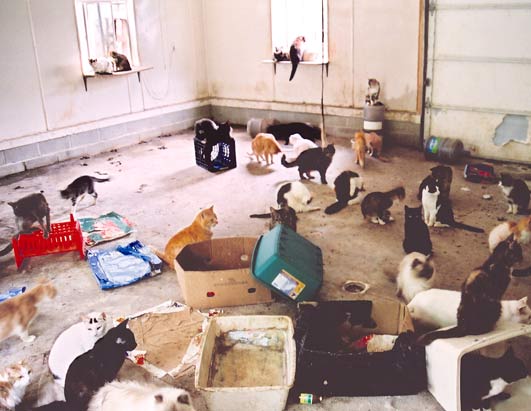
As of Thursday morning, 19 had been adopted into new homes, a good success rate considering the animals may be sorely in need of human socialization. Those problems are the results of people who may have said they loved animals more than anything. It's one of the great contradictions of animal hoarders.
A total of 157 cats were found in a home near Powell, Wyo., last week. That many animals would likely overwhelm local shelters, so they were spread out, some taken to Colorado shelters where there's a relatively high adoption rate. But it hardly solves the problem.
"These are cases that challenge the system almost at every level," said associate professor Philip Tedeschi of the Insitutute for Human - Animal Connection at D.U.'s Graduate School of Social Work.
Tedeschi has been looking at what triggers collecting or hoarding of animals. Often, it involves mental illness.
"From the animal welfare standpoint collectors, or hoarders are very serious animal abusers," said Tedeschi. "The causes are not criminal in nature."
Which makes it tough for our justice system -- designed to protect people, not animals -- to make the right moves to stop hoarding.
It's very common for people to identify with the looks of animals. Human children have larger eyes, heads and other attributes that can make them more attractive to us. Domestic animals have that look (my dog's cuter than yours) that can get them attention and food.
"You take cats for example that have large eyes, have kind of the facial features of a child. Many hoarders and collectors identify with that animal as needing them and needing their protection."
It's often the act of "saving" is bigger than the keeping of the animals.
"In fact the response to the animal once it's been rescued is very different than the initial reaction to help that animal ... In many cases it might be a form of ignoring or neglect itself, there's even been evidence to suggest the individual might not even see the animal."
That may help explain some of the horrific conditions found in hoarding cases. People suffering almost a delusional level of not being able to recognize that animal is present can ignore the animals' basic needs. In Wyoming, the cats were locked in filthy rooms. The level of ammonia was so bad, rescuers had to wear respirators.
The owners -- an elderly couple (most often hoarders are middle-aged or older woman and frequently Caucasian) may not have been able to recognize the conditions that were right in front of them.
One of the owners told a Montana television reporter, "It's terrible, they're all gone."
The inability to see how bad it is, is common. It's "One of the reasons you might see one of these incredible landscapes within the household themselves where you might see the carcass of an animal or the skeleton of an animal," said Tedeschi.
For some the origins of the desire to help animals may be based in their childhoods.
"We have evidence that animals play an important role in kind of role in emotional support. In some cases for example in neglect cases where that animal takes on a primary role in preventing loneliness for a child."
If they turned that way for comfort in the past, they turn again later in life.
It's a mystery not likely to be solved with tougher enforcement of laws Tedeschi believes, but broader involvement of mental health in cases of hoarding to prevent repeats.
Sunday, August 1, 2010
Sunday, July 25, 2010
Pit bull bites Oakland 7-year-old in face
OAKLAND — A 7-year-old girl was bitten in the face by a pit bull in an Oakland neighborhood Saturday afternoon, just days after a Concord boy was mauled to death by a group of pitbulls.
The girl was taken to Children's Hospital where she was in stable condition Saturday night, said Lt. Chris Landry of the Oakland Fire Department. Oakland police and Alameda County animal services also responded at about 2:45 p.m. Saturday in the 2800 block of 82nd Avenue.
Police spoke to a neighbor who owned the dog, but it was unclear what happened to the dog, Landry said.
The incident occurred two days after a 2-year-old Concord boy was killed when he was attacked by three of his family's pit bulls in the garage of his home.
The boy's stepgrandfather was arrested on suspicion of child endangerment and owning mischievous animals that result in death. Steven Hayashi, 52, was being held in Contra Costa County Jail on $120,000 bail Saturday night.
Hayashi's five pit bulls were euthanized by Contra Costa animal services after the attack.

The county coroner's office identified the boy as Jacob Bisbee.
Saturday, July 10, 2010
Gulf Oil Cleanup Crews Trample Nesting Birds
Standing on a white-sand beach at Florida's Gulf Islands National SeashoreThursday, blotchy stains from the Gulf oil spill could be seen creeping past the red-lettered "keep out" signs meant to protect nesting shorebirds.
And, according to conservationists, some well-meaning cleanup crews who unknowingly walk into nesting habitat may be doing more harm than the oil itself, experts say.
From April to August each year, rare shorebirds such as the snowy plover and least tern lay nests of two to three eggs directly on the softly undulating, open dunes about 40 feet (13 meters) from the water's edge.

Snowy plovers and least terns are considered threatened in Florida. When nesting, both species' survival depends on limited contact with people.
But with oil encroaching on Florida's coasts, an army of cleanup crews has descended on the seashore. About 44,300 people are now de-oiling roughly 450 miles (720 kilometers) of Gulf coastline, according to the website for theDeepwater Horizon Unified Command, the joint federal-industry task force responding to the Gulf oil spill.
With so many people working so close to breeding grounds, frightened adult birds are abandoning their nests, and adults and chicks are being inadvertently trampled. (See "Gulf Oil Spill Pictures: Ten Animals at Risk.")

"Most of us know that the cleanup can do more damage than the oil could ever do," said Riley Hoggard, a resource-management specialist for Gulf Islands National Seashore (picture).


"Our bigger responsibility is to the [wildlife], whether it's to a turtle nest or nesting shorebirds. If we have to get cleanup teams off the beach, we'll do that—and deal with the oil cleanup later."
Subscribe to:
Posts (Atom)