Thursday, April 1, 2010

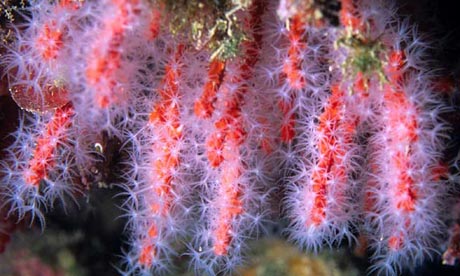
Curbs on Coral Trade Rejected at U.N. Conference


DUBAI, March 21 (Reuters) - A U.N. conference rejected on Sunday trade restrictions on red and pink corals used in jewellery in what environmentalists called a new setback for endangered marine species.
Delegates at the 175-nation meeting of the Convention on International Trade in Endangered Species (CITES) in Doha failed to back a U.S. and European Union proposal to limit trade in 31 species of corals, found from the Pacific to the Mediterranean.
"Vanity has once again trumped conservation," said David Allison of Oceana, which calls itself the world's largest international ocean conservation group, of the decision that would have affected trade worth tens of millions of dollars.
"Today is yet another example of CITES failing to protect endangered marine species," he said. On Friday, the March 13-25 conference also rejected a proposal to ban trade in bluefin tuna, prized as sushi in Japan.
Sunday's coral proposal fell short of the needed two-thirds majority by mustering 64 votes in favour with 59 against and 10 abstentions, delegates said.
The proposed restrictions would have stopped short of a trade ban but required countries to ensure better regulations and to ensure that stocks of the slow-growing corals, in the family coralliidae, were sustainably harvested.
CATCHES DROP
Catches have dropped to about 50 tonnes a year in the main coral grounds in the Pacific and the Mediterranean from about 450 tonnes in the mid-1980s, the U.S. and EU proposal said.
In Italy, top quality beads fetch up to $50 per gramme and neckaces sell for up to $25,000, it said. Main harvesting and processing centres include Italy, Japan and Taiwan. The United States is the largest market for red and pink corals.
Some nations objected it was complex to identify the red and pink corals at customs posts. But some rare corals, including black corals, are already protected by CITES.
The wildlife trade monitoring network TRAFFIC and conservation group WWF said they were "deeply disapointed" by Sunday's vote. Measures to protect red and pink corals were also rejected the last time CITES met, in 2007.
"Without the trade control measures this would have introduced, the current overharvesting of these precious corals will continue unabated," said Ernie Cooper of TRAFFIC Canada.
Separately, CITES unanimously approved a proposal by Iran to ban all trade in Kaiser's spotted newt, a type of salamander from Iran, delegates said. The newt is under threat from trade agreed over the Internet by collectors.

Tuesday, March 16, 2010

3 tigers very ill at Chinese zoo where 11 starved

BEIJING — Zookeepers are scrambling to save three seriously ill Siberian tigers at a cash-strapped zoo in northeastern China where 11 of the big cats starved to death recently.


The three tigers were shedding fur, had lost their appetites and were listless, the official Xinhua News Agency reported late Monday.


Eleven of the 30 Siberian tigers at the Shenyang Forest Wild Animal Zoo starved to death in the past three months, having been fed nothing but chicken bones as the facility ran into financial trouble, according to reports last week, although a zoo manager said unspecified diseases killed the animals.


Staff at the zoo who answered the phone Tuesday refused to answer questions or give their names. They referred calls to the local Communist Party press office, where an official, Zhang Qingyang, confirmed that three tigers were still very sick.


"We can only say that three of the tigers are in bad health right now, and we are actively working to save them," Zhang said but wouldn't elaborate. "Should we fail to save them, we'd let the public know right away."


After news broke of the mass tiger deaths last week, the local government pledged 7 million yuan ($1.03 million) to help save the remaining animals.


Since then, staff have cleaned and installed heating in the cold, damp tiger cages, given the animals nutritional supplements and started feeding them 6 pounds (2.5 kilograms) of beef and two hens per day, Xinhua said.


Siberian tigers are one of the world's rarest species, with an estimated 300 left in the wild, 50 in China. But more than 5,000 are held captive on farms and wildlife parks across China.


Several other protected animal species have also died at the zoo this year, including a red-crowned crane, four stump-tailed macaques, a rhesus monkey and a brown bear, Xinhua said over the weekend.


Monday, March 1, 2010

SMALL DOGS ORIGINATED IN THE MIDDLE EAST


Small dogs the world over can all trace their ancestry back to the Middle East, where the first diminutive canines emerged more than 12,000 years ago.
A new study, which appears in BMC Biology, focused on a single gene responsible for size in dogs. Researchers found that the version of the gene IGF1 that is a major determinant of small size in dogs probably originated as a result of domestication of the Middle Eastern gray wolf, which also happens to be smaller than many other wolves.
In terms of which came first, big dogs or small dogs, the answer is now the former.
"Archaeological studies suggest that ancient (dog) remains found in Belgium, Germany and Western Russia, which date to 13,000-31,000 years ago, were most similar in body size to the Great Dane, while those from the Middle East dating to about 12,000 years ago were most similar to a small terrier," lead author Melissa Gray told Discovery News.
For the study, Gray, a researcher in the Laboratory of Genetics at the University of Wisconsin, Madison, and her colleagues traced the evolutionary history of the IGF1 gene. To do so, they surveyed a large sample of gray wolf populations, other wild members of the Canidae family, and numerous breeds of dogs.
Gray and her team first confirmed that all domesticated dogs trace their heritage back to gray wolves. She indicated the jury is still out as to when and where the world's first dog -- of any size -- emerged.
All small dogs, normally weighing 20 pounds or less, share the variant of IGF1 also found in Middle Eastern gray wolves, the scientists discovered. This means the gene must have surfaced early in the history of small dogs, but after dogs in general were first domesticated.
The DNA studies, combined with the archaeological record, then suggest that at least 12,000 years ago, the first domesticated small dogs entered the world, with humans playing a major role in the process.

Magazines Make Great Gifts!

Tuesday, February 23, 2010

Coral reefs in danger of being destroyed


All of the tropical coral reefs in the world will be disintegrating by the end of the century because of the rising acidity of the oceans caused by a build-up of man-made carbondioxide in the atmosphere, a study has found.
Coral reefs start to disintegrate when the acidity of the oceans rises beyond a certain threshold, and this point is likely to be reached before 2100, said Jacob Silverman of the Carnegie Institution of Science in Washington.
Carbon dioxide in the air dissolves in the sea to form carbonic acid, which interferes with the ability of coral organisms to make their calcium carbonate shells which form coral reefs, Dr Silversman said. But once the shells stop forming, the reef quickly crumbles.
A mathematical model was used to study how 9,000 coral reefs from around the world would respond to rising levels of carbon dioxide and increasing ocean acidity, Dr Silverman told the American Association for the Advancement of Science in San Diego.
"A global map produced on the basis of these calculations shows that all coral reefs are expected to stop their growth and start to disintegrate when atmosphere CO2 reaches 560 parts per million – double its pre-industrial level – which is expected by the end of the 21st-century," he told the meeting.
"Thus these ecosystems, which harbour the highest diversity of marine life in the oceans, may be severely reduced within less than 100 years."
The findings were based on a detailed study of how increasing acidity affects the metabolism and growth of a large area of fringing coral reef in the northern Red Sea. The scientists found that the ability of corals to form their calcium skeletons was strongly dependent on acidity and, to a lesser extent, temperature.
Coral reefs are sometimes considered to be the "rainforests of the oceans" because they are home to a wide variety of fish and other wildlife, supporting about a quarter of all marine organisms. They also provide food for about 500 million people around the world. Atmospheric levels of carbon dioxide are higher now than at any time in the last 650,000 years, and are continuing to rise as a result of the burning of fossil fuels. Between a third and a half of the CO2 produced since the start of the industrial revolution has dissolved in the oceans.
Scientists have estimated that some 118 billion tonnes of carbon released into the air as carbon dioxide between 1800 and 1994 has been taken up by the oceans.
Dr Simon Donner, of the University of British Columbia in Canada, said increasing ocean temperatures also make coral reefs more susceptible to "bleaching", caused by the loss of the photosynthetic algae on which the coral organisms depend.
Corals have a symbiotic relationship with the microscopic algae that live in their tissues. As well as giving coral its vibrant colour, the algae provide the reef creatures with most of theirenergy.

Mad man throws puppies over sea wall


Three rescued puppies are recovering after being thrown over a seawall and on to some rocks in Port Arthur.
Firefighters rescued the crying pups and placed the creatures with animal control.
KFDM-TV reports the man who tossed the animals on Sunday was heard saying he was "turning them into soldiers." A bystander noticed the abandoned puppies and summoned help.
Pat Lavergnec with Port Arthur Animal Control says the puppies, with health problems such as mange, were at the shelter today and available for adoption. She described them as a retriever mix.
The owner of the dogs, who was not immediately located, could face animal cruelty charges.
Banner 468x60 Animated

Friday, February 19, 2010


The San Diego Zoo ushered in Valentine’s Day with a bundle of joy that’s not so little.
A male African elephant was born about 2 a.m. Sunday at the zoo’s Wild Animal Park.
He and his mother Ndlula are reportedly doing well. Visitors camping overnight at the zoo could hear the herd trumpeting in the early morning -- a common behavior when a calf is born, according to the Associated Press.
The elephant, which hasn’t been given a name yet, is the sixth calf born to a herd that was brought to the park in 2003 from Swaziland.
Officials have not released the calf’s weight, but newborn African elephants typically weigh between 200 and 250 pounds and stand about 3 feet tall. The calf weighed 224 pounds at birth, and he came into the world unexpectedly early, said Yadira Galindo, a spokeswoman for the Wild Animal Park. Zookeepers had anticipated a birthdate of later in the month, so they had not yet set up a 24-hour watch. They learned about the birth after campers participating in the “Roar and Snore” sleepover program reported a commotion about 2 a.m.
“They heard all the trumpeting and all the noises, and when the sun rose they went out there and looked and saw the baby elephant out in the yard with the entire herd,” Galindo said. “The mothers were forming a protective circle around him, which is very natural behavior.
Drs. Foster and Smith Inc.

Thursday, February 18, 2010

Zebra runs amok in US traffic

Rush hour traffic in the US city of Atlanta came to a standstill when an escaped circus zebra galloped along a busy section of highway.

The animal was first spotted around 4.30pm on Thursday in downtown Atlanta, said Georgia Department of Transportation spokeswoman Monica Luck.
The animal made its way through downtown to the interstate highway that cuts through the centre of the city. Police cruisers blocked off all southbound lanes and were able to herd the zebra over to the right shoulder and off an entrance ramp, Luck said.
"It wasn't on the highway very long," she said. "But it was an inconvenient time for this to happen because the downtown connector southbound usually gets backed up on its own, that time of day."
Ringling Brothers and Barnum & Bailey Circus is in town this week. The circus also had a group of elephants corralled Thursday in a downtown Atlanta parking lot.
It's not the first time a zebra has been spotted along a metro Atlanta highway.

Magazines Make Great Gifts!